Sunday, August 22, 2010

Article: Radical Homemaking?

From Sunday's San Francisco Chronicle

Yet another way of labeling the 'trend' away from Velveeta. Dropping out in the 21st century makes news, but more like nontrevercy. However, the author does try to stir it up. She brings on a professor of sustainable design at UC Berkeley, Jessica Carew Kraft. She said, "At the end of the day, after you've recycled gray water into your garden, biked to work and washed a hundred diapers by hand, you've done a lot of good for yourself, but have you really changed the world?" Kraft asks. "Radical homemaking can become too self-righteous." I think if a quarter of us would do a quarter of that, we would be changing the world.

Read the Chronicle Article

Another radical, Robin Johnson Simpson, of Belmont, has an interesting blog Frustrated Farmgirl.

NPR Story about food carts


Nice national story about food carts in different cities (or maybe just Seattle, although this is not disclosed in the story). Charla Bear says a number of new chefs use mobile kitchens as lower risk first ventures before moving into brick-and-mortar establishments.

Mobile food seems all the buzz here lately. My family and I visited this Saturday's street food event sponsored by La Cocina in the Mission. The food was great and the street was packed. It was a dilemma whether to chose a stand for its fare or for how short the line was. We compromised with our stomachs and settled for a pair of kati roles from Kasa Indian Eatery. One was chicken the other vegetarian and both were yummy.

Hear the story

Friday, August 13, 2010

San Francisco Art and Politics


I picked up a free paper called San Francisco Art and Politics at a coffeeshop and found two thought provoking articles in it. One was a short article about a San Francisco newsletter from the 70's called Turnover: The Newsletter of the People's Food System. Five front covers were reproduced as well as an article about food politics by Pam Pierce (author of our food growing bible, The Golden Gate Gardener). The writer mentions that issues can be seen at the History Room of the San Francisco Public Library as well as the Prelinger Library. I can't wait to peruse them.
The other was entitled Stone Soup. In it Ellen Roggermann exposes her thoughts on the loss of communal food sharing and subsequently the social glue that used to provide. The most interesting point she makes is that some place are beginning to revive communal ovens that apparently were fixtures in many European villages and likely still are in other parts of the world.
It begs the question: How much further can we push the idea of community gardens? How about community orchards? Sheep herds? Cheese dairies? Fish farm? Not that this is that novel an idea.
Check out the community chicken coop in How-to Homestead videos website.
And pick up a copy of San Francisco Art and Politics at your local independent bookstore (better yet, get it at Green Arcade, a great newish bookstore specializing in environment/landscape/local history, near the corner of Gough and Market St.)

Turnover cover image from Found SF, Chris Carlson's wikisite of San Francisco history.

Monday, August 9, 2010

Portland, Oregon - a movable feast


My favorite personal discovery during our summer road trip was the

food cart scene in Portland. It is funky delicious, and a whole lot of fun seeking great eats scattered around the city. We had a yummy and filling breakfast at the Waffle Window (if you go, don't forget to get a side of pepper cured bacon) followed by lunch the same day at a Vietnamese cart downtown.

If serendipity in eating is not your thing, you can take out the guess work by visiting virtually at Food Carts Portland http://www.foodcartsportland.com/
Even if your are not planning a trip soon it is worth a web visit to get a flavor for the variety and liveliness of this scene. Maybe we could import some of this to the Bay Area.

Quote: Planting for the future

Dean Crowford quoting Glenn Roberts of Anson Mills, Charleston, South Carolina -

"He mentioned the Southern tradition of planting a pecan tree not for oneself but for one's grandchildren, since the pecan takes sixty-five years to bear."

Gastronomica, Spring 2010

Tuesday, August 3, 2010

Leaping Lamb Farm Stay

My family and I had the great pleasure of traveling to Oregon this summer, running away from the fog, and having four glorious days in this farm near Corvalis. Apart from reducing our standing blood pressure reading by at least 10 points, we got to see some of the inner workings of a hobby farm.

The inside view both inspired and tempered our fantasy of "living the dream" in a farm of our own. The place was beautiful and pastoral, especially as seen through our cabin windows while reclining in a comfortable chair, and from the perspective of our unhurried vacation mode. At some point however, I realized that what looked to me as a landscape to contemplate looked like an endless check list of chores to our farm hosts. For them there seemed to be a relentless pace, a rhythm to each day, that needed tending to without fail. I was never under the illusion that farming would be easy work but it was nonetheless sobering to realize the constancy required.

Our hosts, Scottie and Greg, were very friendly and invited us to join in for the most pleasureable of the tasks. The kids most enjoyed ringing a small cow bell on a string to bring in the sheep, the horses, and a donkey named Paco.

We wandered about the farm at our leisure. It was wonderful and I highly recommend this farm stay especially for families with kids. We hope to return a number of times while the kids are young.

Wednesday, July 7, 2010

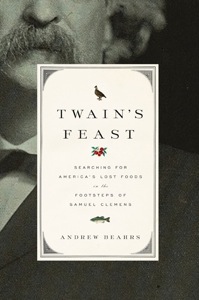
Book: Twain's Feast


This wonderful summer read is a quest by Berkeley-based author, Andrew Beahrs. While Twain was on an extensive tour of Europe he had a terrible bout of home sickness. He expressed this by denigrating the food he was served throughout the continent and by creating an imaginary American menu, the feast referred to in the title (he included the list in his "A Tramp Abroad", 1880).

What is amazing about this recounting is that more than a century later, Twain's Feast should strike such a relevant chord. Most of the items he fondly desires are rooted in a specific place and would have been eaten only fresh and in season. It reminds us that we are not so much inventing a new way of sourcing our food - rooted, fresh, and limited in geography - but returning to what was. It is a view to a time before freight trains and refrigeration homogenized our American palate.

It is also a reminder that food was one of the most important way in which place was distinguished. Not mussels, but San Francisco mussels steamed in their shell. Not just bacon, but Virginia bacon, broiled. Twain was not just day-dreaming of taste but also the flavor of a place.

It may seem obvious to say that this connection between place and food must in part be driving our impulse to local food. In choosing to eat a more rooted cuisine we are helping to distinguish our city, town, village, etc. I, for one, celebrate this renaissance of difference.

Taking off from this idea Beahrs dives into an investigation of a select few items from Twain's menu. It has been quite a treat to go along for the ride.

Thursday, August 6, 2009

KQED's Forum Features Ghost Town Farm's Novella Carpenter


On tomorrow's Forum program, Michael Krasni will interview Novella Carpenter who has been running an urban farm in Oakland. She is a journalist as well as farmer and has published a book, Urban Farm. KCRW also interviewed her recently in a program called Good Food (great program).
So listen in tomorrow or anytime throught the Forum archive.


Here is the episode of Good Food with Carpenter's interview

Monday, July 6, 2009

Tom Philpott on the media voices of food politics

In this article on Grist.com, Tom Philpott gives a nice run down of the growth in media attention about our food systems. I thought it was especially relevant to link to his column after my post on Pollan's talk. Tom seems to be wondering if a more diverse discussion can emerge from under the "long shadow" cast by Michael P's work.

Well, just in the last hour I read, aside from Tom's article, two items in the New York Times magazine (I know... this is M.P.'s main vehicle) on Will Allen's Growing Power in Milwakee and another item, with recipes, about D.I.Y.'s in blighted Oakland (curing meats, foraging, and canning). There is some variety after all and these four are good reads. So here are the links and enjoy:

Tom Plilpott Grist.com

Street Farmer (Growing Power's Will Allen)

Home Sweet (Urban) Homestead

Gut Check, Ezra Kleins new food politics column in the Washington Post

Saturday, July 4, 2009

Swap your excess production a la Forage Oakland


In the latest issue of San Francisco Magazine there is a write up about Asiya Wadud, founder of Forage Oakland, one of my favorite blogs (see blogroll right). I would love to start a gleanig swap right here in San Francisco. Email if you would like to participate and I can schedule a date, time and place to share.

Here is the description of Asiya's work on the Magazine's website. I guess for the full article you'll have to see the issue.

Don’t get stuck with a lemon
You will, if you have a tree that produces more than you can use—an all-too-common embarrassment of riches that inspired Chez Panisse bartender Asiya Wadud to establish Forage Oakland. When she noticed piles of backyard fruit left rotting on the ground all over South Berkeley and North Oakland, she decided to create an online community where people can trade their excess lemons, figs, or anything else. Now, between shifts at the restaurant, Wadud spends her spare time bicycling through Rockridge and Temescal, gathering tree fruit and redistributing it among the group’s 200-plus members, forageoakland.blogspot.com

Now Hear This - Conscience-in-chief, Michael Pollan puts it all together in one talk

Some may say that Pollan over-dominates the issue but no one articulates the principles of the growing food revolution like he does. KQED aired this talk three days in a row and if you missed it, check in to the Long Now Foundation website where it will soon be available as a podcast. It is amazing that Pollan has such a comprehensive view. My favorite, for the moment, point is that of all the ills in the world today (most of which make mortals like me feel overwhelmed) reforming the food systems is empowering. We are the change we want to see by the choices we make when we procure our food.

Here is the program description and link to Long Now Foundation:
Michael Pollan Deep Agriculture (The Long Now Foundation): Deep Agriculture: Re-solarizing the Food System to Fight Climate Change and the Health Care Crisis -- This special program consists of a seminar on long-term thinking produced by The Long Now Foundation and featuring Michael Pollan. Pollan will describe his program to transform American agriculture as a "sun food agenda." Hes the author of In Defense of Food: An Eater's Manifesto and The Omnivore's Dilemma: A Natural History of Four Meals. Pollan is also the director the Knight Program in Science and Environmental Journalism at UC Berkeley. This seminar about long-term thinking is hosted by Stewart Brand and was recorded at the Herbst Theatre on May 5, 2009.

http://www.longnow.org/

Thursday, May 21, 2009

Chicken Coop Chic on the Radio


I recently read a slimly substantiated op-ed piece on Slate about the supposed media driven non-trend of backyard chicken rearing. The author contended that these news items were popping up and that news outlets where all feeding off each other. The argument hinged around the fact that the numbers were never included. Well a raspberry to you, Slate. In the course of the last few months several friends have expressed interest, had owned chickens in the past, or have begun to build their own coops. The chicken and duck workshop I attended had over 40 attendees. At least three other people I know bought chicks. I either live in a chicken bubble or the trend is real.

So it was great to hear this story on NPR. There is also a link to the "Chicken Whisperer" and his web radio show from Atlanta.

As for our three little ones, it is amazing how fast they have been shedding their downy feathers and how much they grow each day. The kids love to watch them.

Saturday, May 16, 2009

Coop Slides

Chicken Build-a-palooza

Chicken Coop-raising


Today was a full day of shelter building for our new chicks. Although they will be indoors for some time to come, we are getting an early jump by building our yard-tractor coop. This A-frame enclosure is designed so that you can move it around and have the chickens graze on different patches of the yard (and act as a fertilizer spreader). We have to thank our friends Thuha and Debbie for hosting our little build-a-palooza, and Thuha for making sure that 98% of our building materials were reused. She got all the supplies from Habitat for Humanity's East Bay ReStore.
Thuha is building her own poulet chalet at the same time. A great thanks also goes out to our friend Oliver who brought his considerable skills and calculator. Thank goodness he invited Sohcahtoa as well.

And as if Thuha had not done enough, she also got us our downy chicks. She got some of them from a Concord feed store and the rest from a chicken rescue outfit on Sherman Island in the Delta. We have three of them: a Buff Orpington, a Cookoo Maran (a great name for a boxer, don't you think?), and a Welsummer. No one is more excited about our new arrivals than our almost 3 year old son, Elias. This is only the beginning. We'll keep you posted.

Thursday, April 9, 2009

The Chicken Diaries: Workshop at Garden for the Environment


The first chapter of our gallusian (Gallus gallus domesticus) saga begins this Saturday when GFTE is hosting a chicken and duck workshop. I hope that I will be better equipped to handle the responsibility of adding new members into our growing arc of creatures (the kids don't qualify as domesticated animals but we still have to feed them). So many questions. What do you think I should ask? Want to join me? Here is the link.

A Little Off Topic: Weaving to-go


While mining the web on food related material I came across a crusading weaver with a simple loom you can make out of card stock and use anywhere. I tried it out recently with great results. It was fun and meditative. I did much of it in the park while the kids were playing. It was also great to feel that I was doing something that humans have been doing at least since the Neolithic. Instructions and how-to videos are at actionweaver.com

To start with I used some cheap acrylic yarn I found at SCRAP. If you use left over wool and then wash it, it becomes a very tight cloth. I want to try making a bunch of small pieces this way and stitch them together into a quilt-like wool blanket.

Article: NYT, No Progress on Food Safety

Not to be complacently smug about it, but the recent scares with salmonella and nuts did not even raise one of our eyebrows at home. Knowing where most of our food comes from helps us keep a leveled head about this. I'd be interested to know how organic, locally sourced produce compares with industrial production (send me a link if you have seen a study). In light of the fact that dispersed, small-scale food production is one way to increase food safety it is worth examining this angle. The article is at NY Times.

Sunday, March 29, 2009

Documentary: Greenhorns

Check out the trailer of a documentary about new farmers joining in the revolution.

Monday, March 23, 2009

Article: Is a Food Revolution Now in Season?


This past Sunday , the NY Times Business section included a long article about the mainstreaming of the organic and local foods movement. The heart of the argument is that the "revolution" has penetrated even to the top echelon of our government elite. The ebullient mood of many of the movements heavyweights, such as Alice Waters (pictured above), was mentioned several times. Much was made of the posturing among these "pioneers" and some of the leading non-profit lobbies, as they elbow their way to sit at the table with Obama and his administration. But, with all due respect to the godmother of locavoring, a celebrity cat-fight in Washington is quite a boring and unproductive topic.

Given that this article was in the business section I can only assume that its purpose was to gauge the profit potential of a sector now in vogue on Capitol Hill. The author however does paint a candid picture of the situation: while the higher ups are enthusiastic they are handcuffed by a congress that is still in the back pocket of agribusiness. Philosophy talks, money walks.

No matter. As the author also points out, this movement has been steadily chipping away, using a growing purchasing power to force the market. The most optimistic point made in the article is that The Omnivore's Dilemma is now ubiquitous in the halls of congress. Maybe we are in vogue.

Read it at NY Times

Friday, March 20, 2009

Edible Garden at the White House


They did it! Michelle Obama was out there today with a group of elementary school kids preparing some beds for planting. The Obamas, with the help of these same kids, are hoping to grow enough food to supplement the White House kitchen and donate some to a homeless shelter. Read more about it in the White House website and at the NY Times.